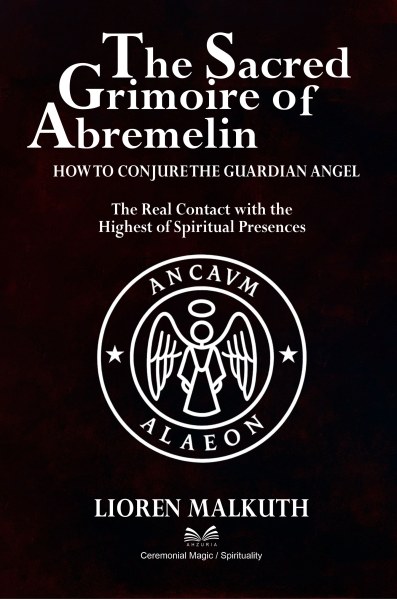
The Sacred Grimoire of Abramelin - Lioren Malkuth

The Sacred Grimoire of Abramelin

How to Conjure the Guardian Angel

Lioren Malkuth

Inglês8.4. Magia Cerimonial
The Sacred Grimoire of Abramelin is a book on the Holy Guardian Angel and the Abramelin system, a guide to ceremonial magic and practical theurgy. Based on the tradition of Abraham of Worms, it presents oratory preparation, the sacred oil, the rule of prayer, fasting, the daily ritual, magical squares, and spiritual defences. It shows how to reestablish contact with the Guardian Angel, seeking protection, clarity in decisions, and whole-person healing, with method, responsibility, and careful records of every operation.

USD 4,20

Comprar e ler

Table of contents

  1. Editorial Presentation
  2. Chapter 1 Life of Abramelin
  3. Chapter 2 Spiritual Objectives
  4. Chapter 3 Sources and Manuscripts
  5. Chapter 4 Central Concepts
  6. Chapter 5 Personal Prerequisites
  7. Chapter 6 Oratory and Space
  8. Chapter 7 Robes and Cleansing
  9. Chapter 8 Abramelin Oil
  10. Chapter 9 Perfumes and Incense
  11. Chapter 10 Rule of Prayer
  12. Chapter 11 Fasting and Temperance
  13. Chapter 12 Purity and Cleansing
  14. Chapter 13 Macro Schedule
  15. Chapter 14 Daily Ritual
  16. Chapter 15 Holy Guardian Angel
  17. Chapter 16 Spiritual Defences
  18. Chapter 17 Four Princes
  19. Chapter 18 Subjugation of Subordinates
  20. Chapter 19 Magical Squares
  21. Chapter 20 Reading the Squares
  22. Chapter 21 Fabrication of Squares
  23. Chapter 22 Prudent Applications
  24. Chapter 23 Errors and Corrections
  25. Chapter 24 Records and Journal
  26. Chapter 25 Integration of Life
  27. Chapter 26 Closing and Continuity
  28. Epilogue

Excerpt from the book

Chapter 1Life of Abramelin

The narrative that follows should not be understood as the product of a fertile imagination or a recent trend, but as the continuation of a tradition that echoes through the centuries. Its starting point lies in the historical figure of Abraham of Worms, a German Jew who lived between the fourteenth and fifteenth centuries. Unlike the stereotype of the hermit secluded in meditation, Abraham was above all a traveller, a man who set out in search of answers to spiritual inquietudes that the religious systems of his time could not satisfy.

The historical context in which he lived was particularly turbulent. Medieval Europe was marked by an interweaving of religious tensions, political disputes, and philosophical advances. Institutionalized faith sought to consolidate itself as the absolute authority, while currents of thought questioned and reshaped the boundaries of reason and spirituality. In this scenario, any knowledge that eluded official dogma—especially of an occult nature—was both feared as a threat and desired as a source of power.

Abraham, however, was not seeking notoriety, riches, or fleeting glory. He was a man who could have lived a secure life, sustained by his social standing and the comfort of a stable existence. Yet, within him there was a profound restlessness: the intuition that the rituals and dogmas permeating the religiosity of…