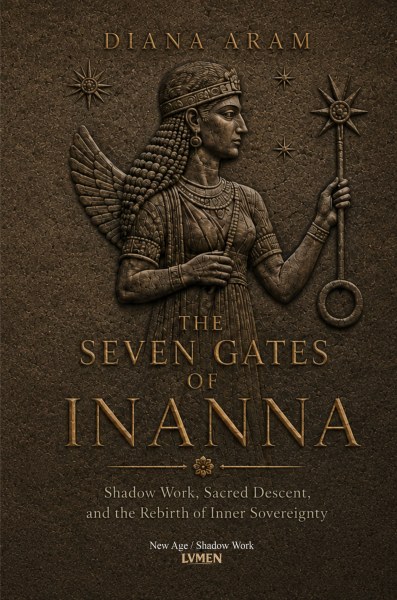
The Seven Gates of Inanna - Diana Aram

The Seven Gates of Inanna

Shadow Work, Sacred Descent, and the Rebirth of Inner Sovereignty

Diana Aram

Inglês8.10. Alquimia8.37. Magia Natural8.29. Anjos e Guias Espirituais
The Seven Gates of Inanna is a serious and intense work on Sumerian mythology, shadow work, sacred descent, symbolic death, and the rebirth of inner sovereignty. Through the ancient myth of Inanna’s descent into the underworld, Diana Aram presents the seven gates as a ritual and psychological structure for understanding the collapse of false authority, the stripping away of identity, and the confrontation with the shadow. The reader will find an atmospheric journey through Mesopotamia, Uruk, Eanna, the divine decrees known as the Me, Inanna’s transformation into Ishtar, Dumuzi, Ereshkigal, sacred marriage, priesthood, offerings, rites of descent, ritual return, shadow integration, and the reconstruction of the sovereign soul. The purpose of the book is to guide readers who feel spiritually stagnant, internally divided, or trapped inside a constructed identity toward a deeper language of crisis, transformation, and inner power.

USD 2,97

Comprar e ler

Table of contents

  1. Editorial Introduction
  2. Chapter 1 Land Between Rivers
  3. Chapter 2 World of the Gods
  4. Chapter 3 Face of Inanna
  5. Chapter 4 Uruk of Light
  6. Chapter 5 From Sumer to Ishtar
  7. Chapter 6 Star and Lioness
  8. Chapter 7 Sacred Desire
  9. Chapter 8 War and Throne
  10. Chapter 9 Inanna and Dumuzi
  11. Chapter 10 Sacred Marriage
  12. Chapter 11 The Call of the Descent
  13. Chapter 12 Seven Gates
  14. Chapter 13 House of No Return
  15. Chapter 14 Deep Ereshkigal
  16. Chapter 15 Death of the Queen
  17. Chapter 16 Return of the Goddess
  18. Chapter 17 Priesthood and Voice
  19. Chapter 18 Cult and Offerings
  20. Chapter 19 Rites of Inanna
  21. Chapter 20 Complete Rites
  22. Chapter 21 Sovereign Soul
  23. Epilogue
  24. Glossary

Excerpt from the book

Chapter 1 Land Between Rivers

The land begins as a flat expanse of wet earth, a hostile plain baking under an unforgiving sun. To understand what was born here, the ground must be touched first. It is thick, dark alluvium, carried down from northern mountains by two violent arteries of water. The Tigris and the Euphrates do not flow with the gentle rhythm of a nurturing mother. They are erratic, prone to sudden floods that sweep away everything in their path. They change course without warning, leaving entire settlements stranded in dust. Yet it is exactly this violence that forces the human hand to act. The mud left behind by the receding waters is the single most important substance in this world. It is the flesh of the earth, ready to be shaped.

When a person scoops this mud from the riverbank, mixes it with chopped straw, and presses it into a wooden mold, a profound transaction takes place. The mold is removed, and the wet block is left to bake in the fierce Mesopotamian heat. This simple object, the mud brick, is the foundation of an entire cosmology. It is the first technology of order imposed upon chaos. Before the brick, there is only the swamp, the reed bed, the formless wild. With the brick, a straight line is…