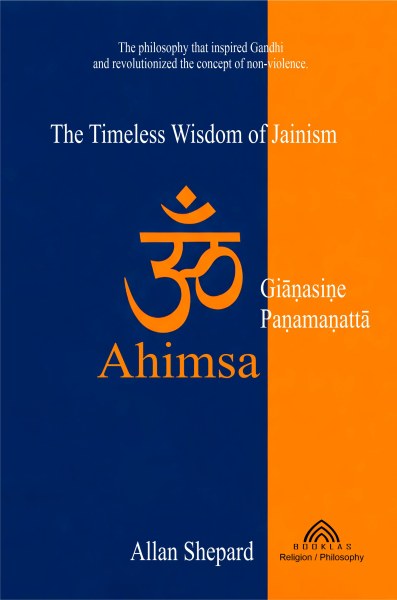
Ahimsa - Allan Shepard

Ahimsa

The Timeless Wisdom of Jainism

Allan Shepard

Inglês17.28. Religião Comparada
Ahimsa introduces Jainism, one of the oldest religions in the world, and its principle of non-violence. Allan Shepard walks through the origins, the Tirthankaras, the scriptures and the doctrines of Anekantavada, karma and the liberation of the soul, along with asceticism, monastic life, the Jain diet, temples and festivals. The book also connects Jainism to science, environmentalism, peacebuilding and interreligious dialogue, and offers a guide to understanding compassion, ethics and inner freedom in today's world.

USD 4,20

Comprar e ler

Table of contents

  1. Prologue
  2. Chapter 1 What is Jainism?
  3. Chapter 2 Origins of Jainism
  4. Chapter 3 The Last Tirthankara
  5. Chapter 4 Jain Scriptures
  6. Chapter 5 Core Principles of Jainism
  7. Chapter 6 The Cornerstone of Jain Ethics
  8. Chapter 7 The Jain Epistemology
  9. Chapter 8 The Law of Spiritual Cause and Effect
  10. Chapter 9 The Soul and the Non-Soul
  11. Chapter 10 Bondage and Liberation
  12. Chapter 11 Asceticism and Spiritual Practice
  13. Chapter 12 The Path of Purification
  14. Chapter 13 Jain Monasticism
  15. Chapter 14 Jain Practices for Laymen and Laywomen
  16. Chapter 15 The Jain Diet
  17. Chapter 16 Jain Temples and Rituals
  18. Chapter 17 Jain Art and Architecture
  19. Chapter 18 Main Religious Festivals
  20. Chapter 19 The Jain Community
  21. Chapter 20 Jainism and Science
  22. Chapter 21 Jainism and Environmentalism
  23. Chapter 22 Peacebuilding
  24. Chapter 23 Interreligious Dialogue
  25. Chapter 24 Jainism in the Diaspora
  26. Chapter 25 Contemporary Challenges
  27. Chapter 26 The Future of Jainism
  28. Chapter 27 Similarities with Buddhism
  29. Chapter 28 The Enduring Legacy of Jainism
  30. Chapter 29 A Path to Inner Peace
  31. Epilogue

Excerpt from the book

Chapter 1 What is Jainism?

Jainism, one of the world's oldest religious and philosophical traditions, emanates from the vibrant and spiritually rich lands of Ancient India. Often mentioned alongside Buddhism, with which it shares roots and certain values, Jainism nevertheless possesses a distinct identity and a profound worldview that sets it apart. But what exactly is Jainism? At its core, it is a path, a philosophy of life, and a religious tradition that emphasizes non-violence (Ahimsa) above all else, seeking spiritual liberation (Moksha) through the purification of the soul.

To understand Jainism, it is crucial to detach oneself from Westernized conceptions of religion and spirituality. It is not merely a system of theological beliefs or dogmatic rituals, but rather a comprehensive set of ethical principles, ascetic practices, and a worldview that shapes all aspects of the lives of its practitioners. Imagine a philosophy that places individual responsibility at the center of the spiritual journey, where every action, every thought, every word has the power to influence the path towards liberation. That is the essence of Jainism.

The core values of Jainism revolve around the principle of Ahimsa, non-violence in all its forms – physical, verbal, and mental. It is not just about avoiding physically harming other beings, but about cultivating a deep compassion for all life, recognizing the soul (Jiva)…