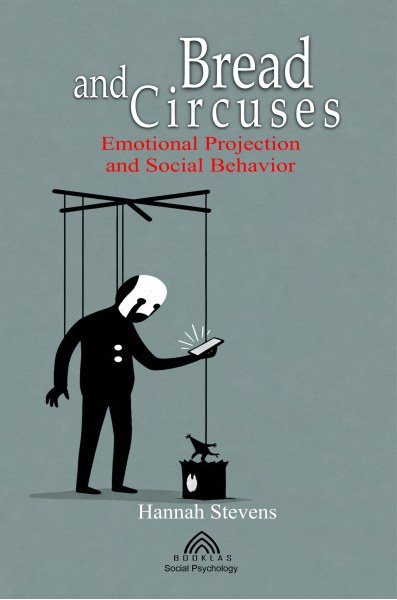
Bread and Circuses - Hannah Stevens

Bread and Circuses

Emotional Projection and Social Behavior

Hannah Stevens

Inglês15.1. Saúde Geral
Bread and Circuses explores social psychology, media influence and emotional manipulation, from the arenas of Ancient Rome to today's digital feeds. The book examines crowd psychology, the herd effect, celebrity worship and political narratives, showing how spectacle captures attention and identity. Through emotional minimalism, self-responsibility and mind reprogramming, readers learn to spot the triggers behind mass influence, reclaim emotional control and write their own narrative with autonomy.

USD 4,20

Comprar e ler

Table of contents

  1. Systematic Index
  2. Prologue
  3. Chapter 1 The Illusion of Conquest
  4. Chapter 2 The History of Bread and Circuses
  5. Chapter 3 The Brain and Emotion Addiction
  6. Chapter 4 Psychology of the Crowd
  7. Chapter 5 The Impact on Individual Identity
  8. Chapter 6 The Power of Narratives
  9. Chapter 7 The Political Use of Emotion
  10. Chapter 8 The Herd Effect
  11. Capítulo 9 As Redes Sociais e a Nova Arena
  12. Chapter 10 The Role of the Media
  13. Chapter 11 The Culture of Entertainment
  14. Chapter 12 The Cult of Celebrity
  15. Chapter 13 Fanaticism and Extremism
  16. Chapter 14 The Price of Alienation
  17. Chapter 15 The Relationship with Social Class
  18. Chapter 16 Exceptions to the Rule
  19. Chapter 17 The Illusion of Control
  20. Chapter 18 How to Break the Cycle
  21. Chapter 19 Emotional Minimalism
  22. Chapter 20 The Power of Self-Responsibility
  23. Chapter 21 The High-Performance Mind
  24. Chapter 22 How to Reprogram Your Mind
  25. Chapter 23 The Art of Detachment
  26. Chapter 24 Creating Your Own Narrative
  27. Chapter 25 Rescuing Emotional Control
  28. Chapter 26 The New Model of Thinking
  29. Chapter 27 The World Without Illusions
  30. Chapter 28 Breaking Free from the Circus
  31. Epilogue

Excerpt from the book

Prologue

Human society has always been guided by shared symbols, narratives, and emotions. From great empires to the hyperconnected world, the need for belonging and validation has been one of the main drivers of collective behavior. Spectacle has always been an efficient tool for distraction and control, and its modern form manifests itself in social media, mass entertainment, cycles of political outrage, and sports and ideological rivalries. The essence remains the same: to keep the public's attention directed toward carefully planned stimuli, while the true centers of power operate without significant resistance.

Humans are driven by emotions, but to what extent are these emotions truly their own? The addiction to external stimuli – whether in politics, sports, or digital culture – creates a cycle where individual identity is shaped by external events and figures. The triumph of an idol, the defeat of an opponent, or the virality of a new trend dictate the mood and daily concerns of millions, often to the detriment of genuine experiences and personal development. The illusion of collective achievement replaces individual victories, and the sense of belonging overrides the search for autonomy and meaning.

The digital age has amplified this phenomenon by creating systems that not only capture but also direct the attention of the masses. Algorithms monitor and shape behaviors, reinforce beliefs, and feed…