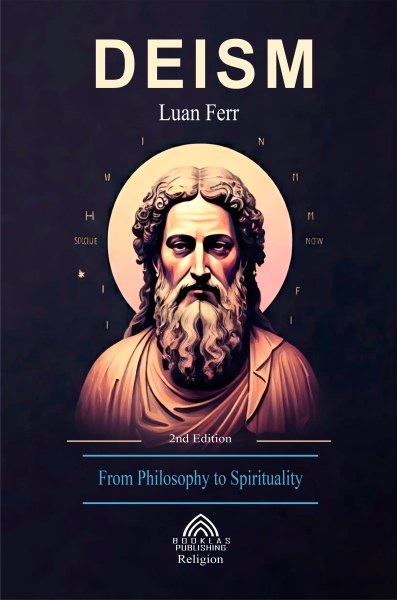
Deism - Luan Ferr

Deism

From Philosophy to Spirituality

Luan Ferr

Inglês17.28. Religião Comparada
Deism, deistic philosophy and rational spirituality: this eBook follows the deist master Marcel Dubois in his search for a Creator God known through reason and the observation of nature. It presents the origins of deism in the Renaissance, intellectual freedom, the dialogue between science and spirituality, the nature of the soul and the practice of this philosophy in daily life. It also profiles famous deists and the Age of Reason, for readers seeking a faith free of dogma.

USD 4,20

Comprar e ler

Table of contents

  1. Marcel Dubois
  2. Luan Ferr
  3. Chapter 1 The Discovery of Deism
  4. Chapter 2 The Awakening of Reason
  5. Chapter 3 The Foundations of Deistic Reason
  6. Chapter 4 The Origins of Deistic Philosophy
  7. Chapter 5 The Universe as an Open Book
  8. Chapter 6 God as Creator and Observer
  9. Chapter 7 The Deist View of God
  10. Chapter 8 Nature as Divine Revelation
  11. Chapter 9 Reason as a Guide in the Exploration of the Cosmos
  12. Chapter 10 Intellectual Freedom in Deism
  13. Chapter 11 The Continuous Search for Divine Truth
  14. Chapter 12 The Synthesis of Deistic Reason
  15. Chapter 13 Science as an Ally in the Search for the Divine
  16. Chapter 14 The Deist View of God
  17. Chapter 15 The Evolution of Representations of God
  18. Chapter 16 The Evolution of Representations of God
  19. Chapter 17 The Universality of the Search for God
  20. Chapter 18 Understanding God in the Modern Age
  21. Chapter 19 Humanity and the Search for God
  22. Chapter 20 God as an Expression of the Universal Mystery
  23. Chapter 21 The Deist Philosophy in Practice
  24. Chapter 22 God Beyond Space and Time
  25. Chapter 23 The Nature of the Soul in Deism
  26. Chapter 24 Contribution to Human History
  27. Chapter 25 Famous Deists
  28. Acknowledgements

Excerpt from the book

Chapter 1The Discovery of Deism

Marcel Dubois was a young doctor in the city of Avignon, France, when doubts about conventional conceptions of God began to haunt him. He grew up in a devout family, attending church regularly and learning about a God portrayed as a paternal, interventionist figure with human characteristics. As he studied medicine and witnessed people suffering, the traditional image of God began to seem inadequate.

Marcel saw people suffering from incurable diseases, children being born with disabilities and a growing disparity between the rich and the poor. He began to wonder how a benevolent God would allow such suffering and inequality.

As his doubts grew, Marcel turned to conventional religious scriptures for answers, but as he read the texts held sacred, he came across descriptions of a God that left him even more confused. God, in these scenarios, was often portrayed as an anthropomorphic being, with human characteristics, emotions and even preferences. This representation of God as a human figure seemed too simplistic for him.

Marcel's first rational reaction after consulting the scriptures was to conclude that God didn't exist, and that's when something inside him refused to adopt such a perspective. His doubts and disenchantment led him to seek a deeper, more personal understanding of God. He longed for a spiritual connection that wasn't limited…